Cooking Classes

Showing posts with label French. Show all posts

8.1.17

Catalan Stew with the warm flavours of chocolate and cinnamon


A few years ago I spent Christmas in Paris. It was two weeks of bistros, fine dining and petits dejeuners. And Paris is where I saw the movie Julie and Julia! It was a rainy afternoon and cold so rather than walk and see more sights I chose the coziness of a movie theatre.

But I digress. I remember one meal in particular at a small quiet yet classy restaurant on Ile St. Louis which was within walking distance of my hotel. I ordered a simple beef stew however, it was anything but simple. The flavours were complex, well balanced, beef perfectly tender with hints of chocolate and orange. I didn't take notes but I thought it was perhaps a daube, a Provencal beef stew, yet I have not found a daub recipe with chocolate. This Catalan stew comes close to what I remember.

Catalan Stew

8 oz. pancetta or other unsmoked cured pork
1/3 c. quality cooking oil such as olive, camelina or organic canola
4 lb. stewing beef, cut into 1-inch cubes
1/3 c. red wine vinegar
2  medium sized yellow onions, finely chopped
3-4 garlic cloves, finely chopped
3 c. beef stock
1 c. dry red wine
2 tbsp. tomato paste
2 - 4 inch cinnamon sticks
4 sprigs fresh thyme or dried
3 strips orange peel
3 tbsp. dark chocolate, coarsely chopped
fresh Italian parsley, garnish

Turn oven to 350 F.

In an ovenproof pot add a tablespoon of the cooking oil and chopped pancetta. Saute until lightly browned. Remove to a bowl.

In three batches brown the beef in the same pan and adding more cooking oil as necessary. Remove to the same bowl as pancetta.

Deglaze pot with red wine vinegar. Add to beef mixture.

Add another tablespoon or two of cooking oil. On medium low heat saute onions and garlic until tender but not browned. Add meat back to pot. Add the rest of the ingredients except Italian parsley.

With the lid on the pot cook in the oven for about 2 hours or until beef is tender. Cool. Refrigerate overnight. Next day remove any congealed fat before warming to serve. Serve in heated bowls garnished with chopped Italian parsley. Or as I did, top a dollop of mashed potatoes with the stew and garnish with roasted baby carrots. Serves 8.


2.1.17

Cassoulet that won't take 3 days to make ...


A fast cassoulet is an oximoron of the greatest degree. There is really no such thing but this is a close facsimile. However, if you are like me, and crave confit of duck leg in it, then it will take a couple of days.

Cassoulet is essentially a French stew and can be made with the meats, beans and lentils on hand. Pork, duck and lamb give it the best flavour but substituting beef for one of these is entirely acceptable.

Unlike a typical stew where everything is thrown into the pot and cooked at the same time a good cassoulet will have the ingredients cooked separately and then mixed together for the final baking.

I am cooking for myself and as a result my recipes often only feed one or two persons. Four at most. I only like to eat leftovers once and I have a decided dislike for most frozen food.

A problem for those who rarely cook with duck or do not live in a large city is the lack of extra duck fat to make the confit. If you are starting with a whole duck it isn't such a problem. The fat from the rest of the duck can be rendered out to use it here. I have a blog post that describes how to render duck fat by clicking on this link How to Render Duck Fat.

Another mild tasting oil can be used in the place of duck fat to make the confit. Canola oil is one option or a mild olive oil.

If making duck confit isn't appealing, then simply sear a duck breast, dice and add to the dish instead.

And if you are not using duck at all, then please use bacon and the rendered fat. Pork belly is delicious. This dish needs some flavourful fat.

And your next question may be, "What do I serve with cassoulet?" Traditionally, nothing is served 'with' cassoulet. You may begin the meal with a crisp salad and of course, a light dessert to finish.

Sarah's Cassoulet
Serves 4.

1 duck breast or confit leg
2 lamb sausages
1/2 lb. beef chuck roast, cubed
1/2 c. navy beans
1 bay leaf
1 sprig thyme
1/2 tsp. kosher salt
1/4 c. French green lentils
1/2 c. yellow onion, chopped
1 clove garlic, chopped
1/2 c. dry vermouth
1 tbsp. tomato paste
1 c. beef, chicken or duck stock
1/2 c. panko bread crumbs
2 tbsp. flatleaf parsley, finely chopped

To Make the Duck Confit

 kosher salt
1 cloves garlic, smashed
1 shallot, peeled and sliced
1 sprigs thyme
Coarsely ground black pepper
1 duck legs with thighs
About 1 cups duck fat

Sprinkle salt in the bottom of a dish or plastic container large enough to hold the duck pieces in a single layer. Evenly scatter half the garlic, shallots, and thyme in the container. Arrange the duck, skin-side up, over the salt mixture, then sprinkle with the remaining salt, garlic, shallots, and thyme and a little pepper. Cover and refrigerate for 1-2 days.

Preheat the oven to 225 F. Melt the duck fat in a small saucepan. Brush the salt and seasonings off the duck. Arrange the duck pieces in a single snug layer in a high-sided baking dish or ovenproof saucepan. Pour the melted fat over the duck. The duck pieces should be covered by fat. Place the confit in the oven. Cook the confit slowly at a very slow simmer — just an occasional bubble — until the duck is tender and can be easily pulled from the bone, 2-3 hours. Remove the confit from the oven. Cool and store the duck in the fat. The confit will keep in the refrigerator for several weeks.


Note: The duck fat can be strained and reused.
To Make the Beans

Soak the beans overnight in cold water (soaking is optional, but makes the texture creamier and the cooking time shorter). Drain, rinse again, and put in a large saucepan or 5- to 6-quart Dutch oven. Add enough water to cover the beans by 1 inch (more, if you didn’t soak them). Add the onion, thyme, rosemary, savory (if using), bay leaf, chile, and salt. Bring to a simmer over medium heat, adjusting the heat as needed to achieve a gentle bubbling. Cover partially and simmer until the beans are tender but still hold their shape. Depending on the variety and freshness of your beans, this could take from 30 minutes to 2 hours, so check frequently, adding more water if the beans get dry. Remove from the heat and let cool in the liquid.

To Put it Together

Begin by adding the cooked navy beans to a baking dish large enough to hold everything else. In this case, I used a baking dish that was about one quart volume.


In a pan over medium high heat place the confit duck leg skin side down. Sear until the skin is crisp and any fat is rendered out. Turn it over and brown the other side, too. Remove to a cutting board. Don't clean the pan. Remove the bones and roughly chop the meat and skin. Add to the baking dish.
Next add the cubed beef. Season with kosher salt and freshly ground pepper before cooking. Don't crowd the pan. Saute until browned and add to the baking dish. Don't clean the pan. And then brown the lamb sausage in the same way. Add to baking dish.


 Saute onions in the same pan. Add to the baking dish. Don't clean the pan.

Deglaze the pan with the dry vermouth. Add tomato paste and the rest of the cooking water from the beans. Add this to the baking dish.

 Stir in French green lentils. Add water to almost cover.


Toss the breadcrumbs with parsley and spread over the top of the food. Put the lid on the baking dish and bake for about 45 minutes. Remove the lid and let the breadcrumbs become crusty, about 15 minutes.
Stir the crusty breadcrumb mixture into the cassoulet and add water if it is dry. Put it back in the oven and bake until the beef and lentils are tender and once again crusty on top.

4.2.15

Pigeonneau Fermier Roti aux Epices Douces

This month we are going to the Oscars. Food can be associated with most movies in one way or another. I like the real hard-core food movies. The only movie, not only foodie movie, but the only movie I saw this year was the One Hundred Foot Journey. It was nominated for the Golden Globes but didn't meet Oscar competition.

Anyhoo, we are here to sit down and enjoy more wonderful food.

I made the 'oh so' elegant Pigeonneau Fermier Roti aux Epices Douces. Yes, this translates as pigeon. The culinary world has chosen a more appealing moniker of squab. Wouldn't we rather eat squab than pigeon? Pigeonneau is a young pigeon.

This recipe was the test for the young Indian chef to work with restaurateur Helen Mirren. He earned the restaurant a third Michelin star.

These restaurants were literally across the street from each other, hence, the one hundred foot journey. He left his family's Indian restaurant to serve haute cuisine and move his career forward.

The sauce with this dish is dazzling. This will be on my fine dinner 'go to' list of choice. And it you think you can forget the madeira, in one word, don't. The subtle sweetness adds another layer of complexity to the flavour.

I did not find pigeon and used pheasant as a substitute. It was delicious.


Into the Woods Bean Soup  with Jerry at A Life, Lived. Movie inspiration is, of course, Into the Woods.

Pimento Cheese Sandwiches from Shelby at Grumpy's Honeybunch. Movie inspiration is Shelby's all time favourite movie, The Help.

Cranberry Orange Trifle by Val at More Than Burnt Toast. The movie inspiration is The Queen with Helen Mirren. She is popular. She is also the leading actress in One Hundred Foot Journey.

Fontal Polenta with a Mushroom Saute is Sandi's contribution from The Whistlestop Cafe. Her movie inspiration is Eat, Pray, Love.


Pegonneau Fermier Rȏti aux Epices Douces

2 tablespoons butter
fine salt
freshly ground black pepper
Preheat oven to(400 °F). Melt the butter in a frying pan over high heat. Season pigeon halves with salt and pepper. Brown one side. Turn the halves over, and place the pan in the oven. Cook for 7 minutes.
Place the baked pigeon halves on a plate, tent with foil, and set aside to rest for five minutes. While the pigeon is resting, continue to reduce the sauce until thickened. Taste the sauce and season with salt, as required. Also, place the serving plates with the vegetables in the oven for a couple of minutes until the vegetables are reheated.
When the meat has rested, slice each half on the bias in four places. Arrange the pigeon slices on the serving plates. Top with the reduced sauce.


Sauce de Pigeonneau
1 small shallot, minced
1 tablespoon butter
100 milliliters Madeira wine
150 to 200 milliliters fond de pigeonneau
Fond du Pigeonneau
bones from 2 young pigeons (squabs)
1 plum tomato, seeded and chopped
1/2 white onion, chopped
1 small carrot, peeled and chopped
1/2 stalk celery, peeled and chopped
Preheat oven to 260 °C (500 °F). Scatter the reserved bones in a baking dish and bake for 15 minutes.
Scatter the vegetables over the bones and bake for an additional 15 minutes.
Transfer the cooked bones and vegetables to a saucepan. Add some water to the roasting pan and deglaze over heat. When all the caramelized partials are loose, transfer them along with the water to the saucepan.
Add sufficient water to the saucepan to cover the bones plus another 50 percent. Bring the water to a boil. Reduce heat to simmer. Simmer the contents for about 2 hours until the liquid is reduced by half. Skim any scum that forms on the surface. When reduced, strain the stock through a strainer and then through a chinois. Check the volume of the stock. If it is greater than about 200 milliliters, reduce further. Refrigerate strained stock until needed. Remove and discard any fat that congeals during cooling.
 
Sweat the shallot in butter in a saucepan over low heat.
Add the Madeira wine and reduce almost totally. Add the fond de pigeonneau and reduce substantially. Strain and return the sauce to the saucepan. Finish reducing the sauce per the main recipe.

27.11.14

Far Breton inspired by David Liebovitz

My sweet tooth is getting the better of me as I watch bloggers make preparations for American Thanksgiving. I am not in my own kitchen at the moment which makes throwing something together more of a challenge. When I came across Far Breton on David Liebovitz's blog I was immediately intrigued. David is an American chef living in Paris and has written several cookbooks.

Not only does it look rather healthy with all the protein from eggs but the small amounts of flour and sugar are doable in my friends' kitchen which is almost devoid of anything resembling an unhealthy ingredient. There are tiny bags of flour and sugar and that's all I need.

Prunes are not as popular in North America as they are in France. I mean, usually they are only served in seniors' care homes, right? I like prunes and when they are soaked in Cognac it raises them to a higher level of deliciousness. I can only hope that by the time I am ready for a seniors' care home they hire proper chefs and make a breakfast like this.

Far is an unusual name for a dish and it refers to a flan. This recipe is much like a crepe batter so this is almost a prune flan but I like the name Far Breton much better. This is also a great recipe if you are preparing breakfast on an already busy day, like American Thanksgiving or Christmas, or if you manage a B & B.

The prunes are steamed in the liquor and soaked overnight. They are better if nice and soft. The batter is made and rests in the refrigerator overnight. I just leave it in the blender jar so I can whiz it again before pouring into the pan. All that is left to do is bake. You still need to rise early because it takes about 45 minutes to properly bake.

I like using a glass pan for dishes like this. I find it gives nicer browning. However, it will hold the heat longer and bake more quickly. I set my oven timer for 40 minutes and it was perfect. Because it's a custard a test for doneness is to insert a knife and if it comes out clean, it is ready.

Far Breton
  • about 2 cups pitted prunes
  • 1/3 cup Armagnac, Cognac, brandy or dark rum
  • 2 cups whole milk
  • 2 large eggs
  • 2 large egg yolks
  • 1/2 cup sugar
  • 1/4 cup melted butter
  • 1 teaspoon vanilla extract
  • 1/8 teaspoon salt
  • 2/3 cup flour
Additional softened butter and flour for preparing the baking dish
In a small saucepan, warm the prunes with the liquor over moderate heat, stirring them a few times while cooking, until most of the liquid is absorbed. Cover, and remove from heat and let cool. The prunes can be done a day or two before using.
To make the custard, put the milk, eggs, yolks, sugar, melted butter, vanilla, salt, and flour in a blender. Blend until smooth. Refrigerate the custard for at least four hours, or overnight.

To bake the Far Breton, preheat the oven to 400 F.
Generously butter the bottom and sides of a rectangular baking dish 10-12 inches  in length.  Dust with flour and tap out the excess. Arrange prunes in the bottom of the baking dish.
Pour the chilled custard over the prunes and bake until the top is gently browned, 45 to 50 minutes. Let cool completely, then slice into bars.
Far Breton can be made up to three days before serving and refrigerated. Bring to room temperature before serving.

11.1.14

Pheasant Cassoulet

With my oven still out of order I am experimenting more with stovetop and slow cooker versions of my favourites. Actually this is a recipe full of experimentation. I set my slow cooker to cook for 4 hours on high heat. This was the setting most appropriate on my cooker. I allowed it to preheat while I prepared all the ingredients.

Cassoulet is a classic casserole from the south of France. It is slow cooked and my favourite has a crusty top. Achieving this in a slow cooker is a challenge but not totally impossible. It usually includes a duck, goose or wild bird confit. It almost always has white beans.

After combining all the ingredients, I cooked it for an hour with the lid on. I checked it and found it to be quite watery so I removed the lid for about an hour. This allowed the excess liquid to evaporate and make it thicker.

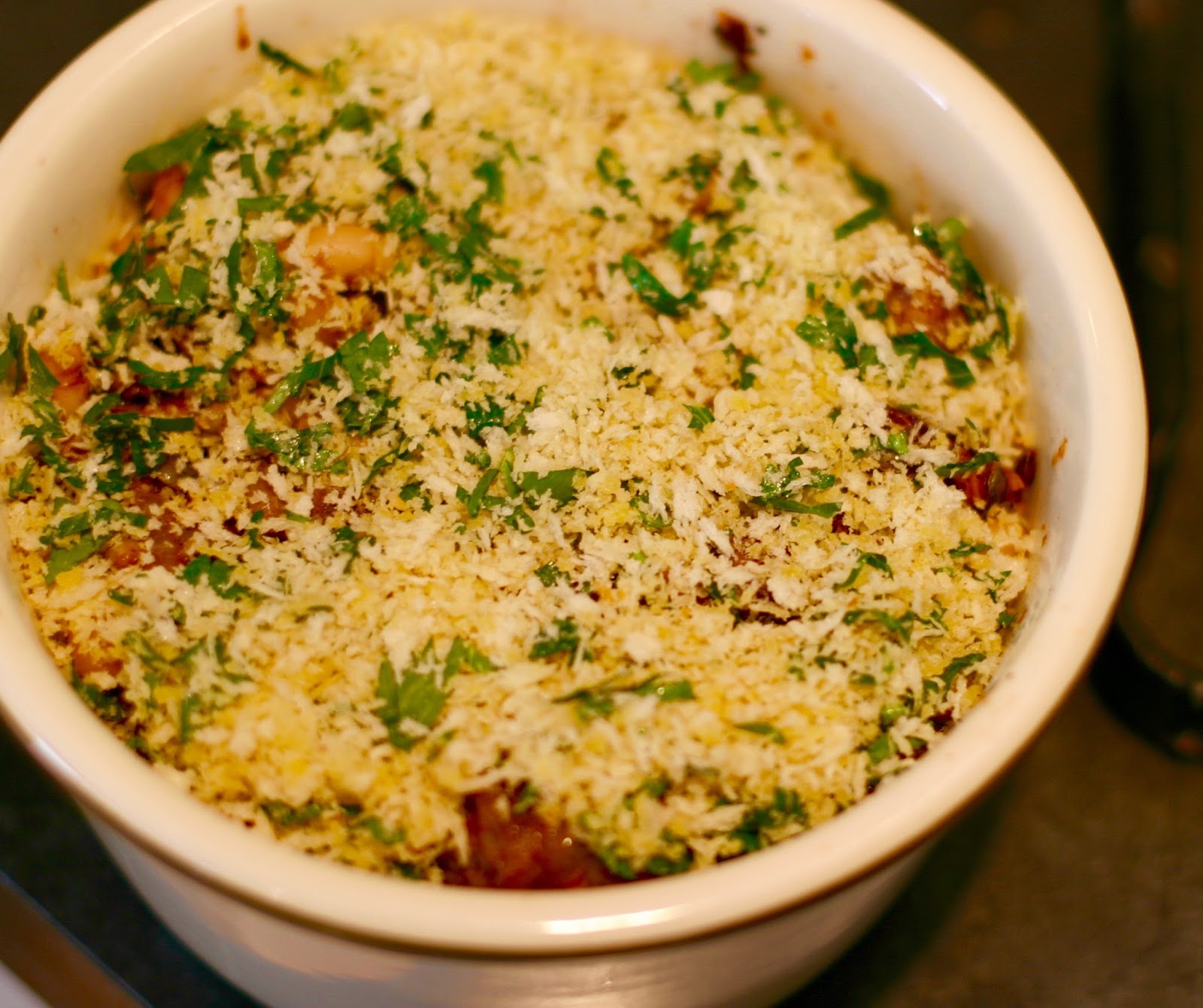
Most recipes call for a breadcrumb topping. These would soak up too much moisture in the slow cooker so I substituted grits. I thought they might plump up a little in the steam but they didn't. They made quite a nice crust on the top.

I found a couple of wild pheasants in my freezer. I am always saving special things for special occasions but I have saved these long enough and freezer burn will soon set in. I also came across cacciatore lardo that I purchased from Salt Food Boutique in Regina. All charcuterie and sausages are house made.

The lardo is a curious looking sausage. It is uncooked sausage meat that is surrounded by a thick layer of fat or lardo. I cut it into cubes and browned it along with Pine View Farms naturally produced smokey bacon.
Now it is ready to add to the preheated slow cooker. I am setting the slow cooker on high heat for 4 hours. That's just the setting most appropriate on my pot.

 It 'baked' beautifully in the slow cooker. I carefully cut out pieces and transferred them to preheated cast iron ramekins for serving. Without an oven, I used a pot with a little water to preheat my ramekins.


Pheasant Cassoulet in a Slow Cooker

1 pheasant, deboned and cut in cubes
1/4 lb. cacciatore lardo
2 slices smokey bacon
1/2 onion, roughly chopped
1 c. navy beans
1/2 tsp. dried oregano
1/2 tsp. dried thyme
2 bay leaves
2 c. pheasant stock
1/2 c. white grits
3 tomatoes, roughly chopped

Add the navy beans to a pressure cooker and fill pot halfway with cold water. Place lid on cooker and put on stove top on high heat. When full pressure has been reached reduce the heat to maintain the pressure and cook for 10 minutes. Turn off the heat and let the pot cool naturally. Drain and discard cooking water. Add beans to slow cooker.

Meanwhile, prepare the pheasant, lardo and bacon. Brown lardo and bacon then add to slow cooker. Add pheasant to the same pan and when it is browned add onions and garlic. Continue to saute until the onions are soft. Add this to the slow cooker.

Add remainder of ingredients, except the grits, to the slow cooker. Stir to mix ingredients evenly. Sprinkle the grits on the top. Set the cooker on high heat for 4 hours and let it cook for about an hour before checking.

After about an hour open the lid and check how much liquid remains. If it is a lot, continue to cook for about an hour without the lid. This will thicken the cassoulet so that it is more like the traditional baked in an oven. Replace the lid and cook for another hour or until the pheasant is tender.

Serve with a green salad. Serves 8.


29.1.13

Dorie Greenspan's "Around My French Table"

I have had this cookbook for well over a year and have barely made a recipe. Digging through my freezer yielded some osso buco that I was saving for a special occasion. Well, today is the day for my lovely osso buco.

In the past I have always made an Italian version. After all, the Italians named this dish and theirs is the typical interpretation. However, Dorie has a French version that looks yummy and that is what I am making today.

Osso buco is veal shank and it means 'bone with a hole'. The shank is sawed into 3-inch slices and has a nice round bone filled with marrow. The marrow is one of the reasons that this dish is so revered. Spoon the marrow onto a piece of crusty bread, sprinkle with sea salt and enjoy.

Because this dish is braised for 2 hours there is always the chance that the meat will fall apart and lose its shape. Although it adds another step, if you tie the meat with kitchen string before braising will hold the shape for a nice presentation. Just snip the string and remove before plating. Your butcher may have already tied it with string.

This recipe can be made up to 2 days in advance of serving and then gently reheated on the stovetop or in the oven. Dorie's recipe used orange zest rather than lemon but I didn't have any oranges today. The lemon was also nice. Don't be afraid to use it liberally. It did not overpower the other flavours.

Osso Buco a L'Arman      adapted from Around My French Table
Serves 2

1 lemon
1 cup water
1 medium onion
1 garlic clove, peeled and crushed
1 tsp dried thyme
1 tbsp chopped fresh basil
1 tsp herbes de Provence
4 oz thick tomato sauce
2 medium roma tomatoes, sliced
1/2 c chicken stock
2  3-inch slices veal shank
2 large carrots
olive oil

Preheat oven to 325F.

Remove the zest from the lemon with a vegetable being careful not to get any of the white pith. Pour water into small saucepan, add lemon zest and heat to boiling. Simmer for 5 minutes. Set aside.

Gently heat a Dutch oven over medium heat with about 2 tbsp olive oil. Add onions, garlic, herbs and cook for 5 minutes. Add tomato sauce, fresh tomatoes, chicken stock and a splash of the water that the lemon zest was cooked in. Reserve the rest of the lemon zest water.

Season sauce with salt and pepper and gently simmer while you prepare the osso buco.

With a large heavy pan heat it over medium high heat and add a splash of olive oil. Pat osso buco dry and season lightly with pepper. Lightly brown in pan. When browned on both sides remove with a slotted spoon and add to the sauce.

Pour oil out of pan and use the rest of the lemon zest water to deglaze and pick up all nice little brown bits and add this to the sauce in the Dutch oven.

Add a couple of strips of the lemon zest to the sauce. Scatter the carrots over the veal. Cover the mixture with a piece of parchment paper that fits the pot. Simmer for 5 minutes.

Oven braise in the oven for 2 hours undisturbed with the lid on.  Remove from oven, remove lid and parchment paper. It should be fork tender. Skim off as much fat from the surface as you can before serving.

Serve with rice pilaf and a lemon olive salad.


10.12.11

The French Mediterranean

 I have been so so busy with cooking classes and the Farmer's Market that blogging has not even been on my radar.  I took a few pictures of my cooking class 'Exploring the Foods of the French Mediterranean'.  We had a wonderful evening.  I had ten guests with an open mind and adventurous palate.

They arrived to a glass of Blanc de Blanc from France.  The champagne locally available is so expensive and I thought this chardonnay prepared in the champagne style might work.  I really enjoyed it.  And at half the price, it would be my pick for a bubbly this New Year's Eve.

Our first taste was pissaladière.  This is a puff pastry crust with carmelized onion, anchovy, caper and black olive topping.  Serve this warm and it is a nice little bite with the bubbly.

The meal went like this.... Pear and Roguefort Salad alongside the Cassoulet.  I had made confit of duck, cooked flageolet beans and added lamb and mild Italian sausage to this classic country dish.  Two days later it was even better.  Confit of duck is an absolute must to make a wonderful cassoulet.

Dessert was a Walnut Tarte and a Buche de Noel.  I had so much fun. 

27.10.10

Coq au Vin à la Julia Child

A few weeks ago my good friend, Val, gave me Julia Child's cookbook, Mastering the Art of French Cooking.  I promised to make a recipe from it and I am finally doing that.  This is a traditional French Coq au Vin.  I have not made this in years.

Although the traditional recipe uses red wine, I had my trepidations.  It was so painful looking in the pot!  Beautiful farm chicken stained red?  But I did it and the result was well worth the initial fears.  The final product was similar to Chinese lacquered duck.

The process was a little more detailed than other chicken stews.  But again, worth the effort.

Boiling the bacon lardons in water before sauteeing removed a lot of their fat and therefore, the flavour did not dominate over the chicken.  I bought pancetta already cut and it was perfect.  It added a nice subtlety.  Then lightly browning them in butter made them very palatable in the dish.

After simmering the chicken in wine and broth, and removing it to another plate, it was time to degrease the liquid.  I have always degreased by cooling the liquid.  Julia's method requires that it is brought to a simmer.  Actually this works, too.  The fat tends to come together around the edges and, even though I removed some cooking liquid, I was able to remove most of the grease.  Also, as the cooking liquid reduced, I did skim off any scum that formed.

I substituted the cognac with calvados ( Grace - just one more time to use up all your calvados! ).  It flamed nicely and burned off the alcohol.

If there was one change I would make, it would be to cut the chicken into pieces large enough that one piece would be a serving.  I cut the breast into three pieces and thus, more than one piece would be required for a serving.  I think it serves much more nicely if one piece of chicken is on the plate.  But then, that is a personal preference.

I like the serving suggestion, that it can be prepared to a point that it can wait 'indefinitely' before presenting.  I think this makes for a wonderful casual dinner party dish.

Traditionally, it would be served with baby potatoes or mashed potatoes and root vegetables or green beans.  I think it would also be amazing with polenta.

This is more of a commentary than sharing a recipe.  You know how detailed Julia's recipes are!  And you all know how to find it!  Adapting it to a simpler version so I can publish it on my blog would be blasphemy.  So I leave you with these notes to follow when you try this.

Bon Appetit!

20.10.10

Apple Crepes with Calvados Butter

 
It is apple season and I just bought a half case of MacIntosh apples from British Columbia.  That is what I used for this recipe.  I think that Macs from BC are the best apples in the world.

Apple Crepes with Calvados Butter Sauce

 
Crepes:
  • 1 cup whole milk
  • 1 cup unbleached all purpose flour
  • 3 large eggs
  • 1/3 cup water
  • 3 tablespoons unsalted butter, melted
  • 1 tablespoon sugar
  • 1 tablespoon Calvados or other apple brandy
  • 1 teaspoon vanilla extract
  • 1/4 teaspoon coarse kosher salt

Calvados butter sauce:
  • 6 tablespoons (3/4 stick) unsalted butter, room temperature
  • 1/2 cup sugar
  • 1/4 teaspoon coarse kosher salt
  • 3 tablespoons Calvados or other apple brandy

Apples
  • 2 tablespoons (1/4 stick) unsalted butter
  • 2 medium-size Golden Delicious apples, peeled, cored, cut into 1/2-inch cubes
  • 3 tablespoons sugar
  • 1/4 teaspoon coarse kosher salt
  • 1/4 teaspoon ground cinnamon
  • 2 tablespoons Calvados or other apple brandy
For crepes:
Combine all ingredients in blender and blend until smooth. DO AHEAD Crepe batter can be made 1 day ahead. Cover and refrigerate. Reblend before using.
Line plate with paper towel or parchment paper. Heat 9-inch-diameter nonstick skillet with 7-inch-diameter bottom over medium heat. Add 2 tablespoons batter to skillet; tilt and rotate skillet to spread batter evenly over bottom. Cook until center of crepe is cooked through and edges are lightly browned, about 1 minute. Run spatula around crepe and invert onto prepared paper-towel-lined plate. Repeat with remaining batter, placing paper towel or parchment paper between crepes, making at least 18 crepes. DO AHEAD Can be made 1 day ahead. Cover and refrigerate.
For calvados butter sauce:
Using electric mixer, beat butter in medium bowl until well blended. Add sugar and coarse salt; beat until fluffy. Gradually beat in Calvados just until incorporated. DO AHEAD Can be made 1 day ahead. Cover and refrigerate.
For apples:
Melt butter in heavy large skillet over medium heat. Add apples; sprinkle with sugar, coarse salt, and cinnamon. Sauté until apples are tender, about 3 minutes. Add Calvados and cook until most of liquid evaporates, about 2 minutes. Remove from heat. DO AHEAD Can be made 2 hours ahead. Let stand at room temperature.
Preheat oven to 300°F. Place crepe stack (with paper towels between crepes) on rimmed baking sheet. Cover baking sheet with foil and seal at edges; warm in oven until crepes are heated through, about 20 minutes for cold crepes and 15 minutes for room-temperature crepes.
Stir Calvados butter sauce in small saucepan over medium-low heat until melted and heated through. Rewarm apple mixture over medium heat, stirring occasionally, about 3 minutes. Place 1 crepe on plate, browned side down. Spoon 2 teaspoons Calvados sauce over crepe, then fold crepe into quarters. Repeat with remaining crepes and Calvados butter sauce, placing 3 crepes on each plate. Spoon apples over crepes on each. Spoon any remaining sauce over crepes and serve.


This is also for Fresh Friday with La Bella Vita!